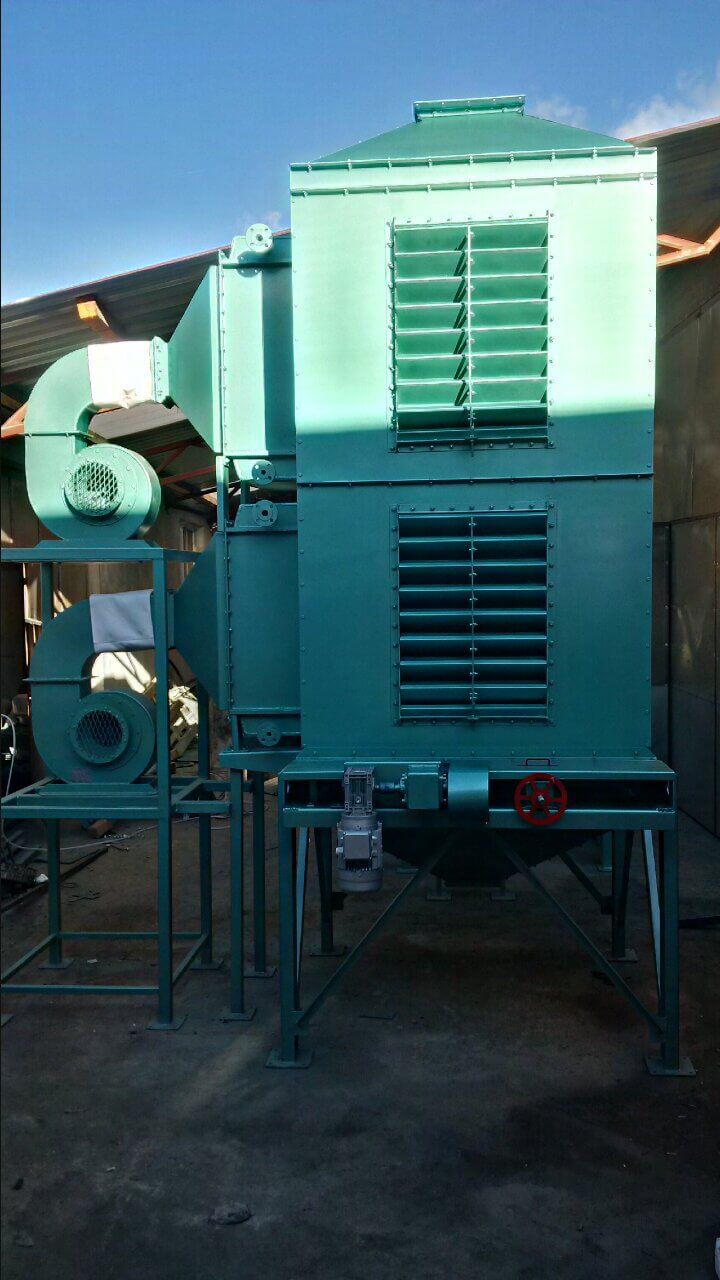
The drying solution for fish feed and pet food. The counterflow principle achieves ±0.5% drying accuracy and reduces specific heat consumption to just 2,500 kJ/kg of evaporated water.
The SE 14xx14 Dryer integrates directly between the extruder and cooler within the continuous food production line
The SE 14xx14 extruded feed Counterflow Dryer is a key component in industrial fish feed and pet food production lines. Using the counterflow air principle, the system achieves maximum energy efficiency and uniform drying.
The dryer reduces the moisture content of wet pellets exiting the extruder — from 20–22% down to the target 8% — with full automatic process control. Pellets leaving the extruder have high moisture content and a temperature above 100°C. Without adequate drying, such a product cannot be safely stored, as microorganisms and mould would quickly degrade the feed.
The dryer thermally stabilises the pellets, ensuring a shelf life of 3–6 months without freezing — by reducing moisture below 10%, the water activity value (a_w) drops below 0.6, the threshold below which pathogenic organisms cannot grow.
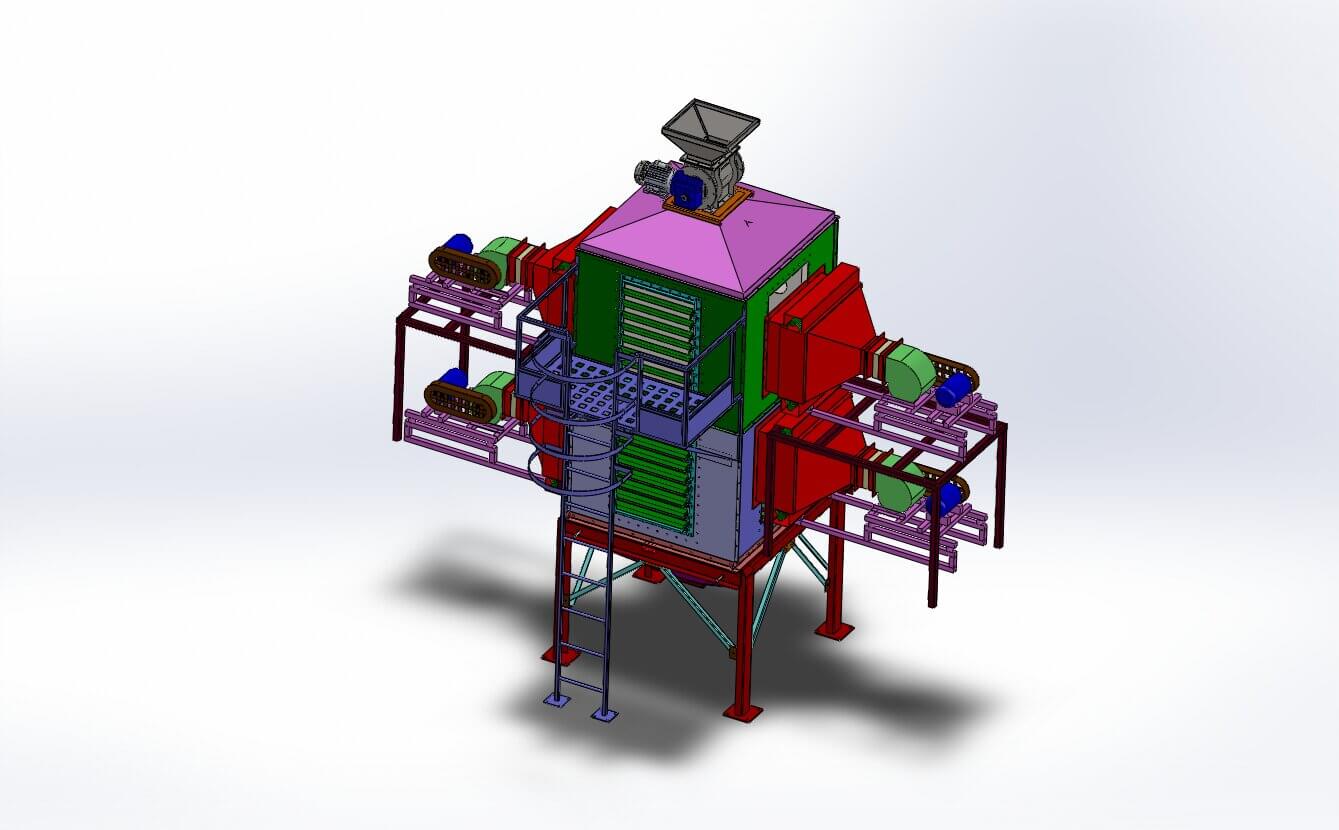
Click on a dot to learn more about that component
Gold dots = key process elements · Teal dots = control systems
Pellets enter the dryer with 20–30% moisture and a temperature of 80–110°C. The porous structure created during extrusion facilitates moisture diffusion during drying.
Wet pellets enter from above, dry heated air enters from below — they travel toward each other. Dry air meets the driest pellets; saturated air meets the wettest.
Pellets are hot and wet — moisture evaporates rapidly from the surface. The high pellet temperature drives rapid initial drying.
Moisture diffuses from the pellet interior to the surface at a constant rate. The air absorbs moisture at a steady pace.
Diffusion slows down; precise control of temperature and airflow is critical for reaching the target moisture of 8% ±0.5%.
Dried pellets exit by gravity without mechanical belts, minimising breakage and preserving the porous structure important for subsequent oil coating.
The counterflow principle allows exhaust air to exit close to the dew point — air is used to the maximum without unnecessary heat loss.
Steam/air heat exchanger
The most practical solution for industrial plants with a central boiler house. Steam passes through a tube or plate heat exchanger, heating the air introduced into the dryer. Precise temperature control with no direct contact between fuel and feed. Waste steam from the extruder can be reused to increase overall facility efficiency.
Industry standardDirect combustion in a burner
Direct combustion of gas in a burner heats the air entering the dryer. Simple installation, fast temperature regulation and low equipment cost. Suitable for plants with existing gas infrastructure and facilities where gas is a cost-effective energy source.
Quick installationLowest specific energy consumption
COP coefficient of 3–5 — for every kW of electrical energy, 3–5 kW of heat is delivered. Ideal for facilities with strict CO₂ reduction requirements. Heating air temperature typically up to 60–70°C, sufficient for gentle drying of smaller capacities.
COP 3–5 · Eco-FriendlyWood pellets or agro-pellets
Burning wood pellets or agro-pellets (straw, sunflower, grain mass) in a boiler generates warm air that is fed into the dryer. A CO₂-neutral energy solution. Fuel costs are lower than gas and electricity — particularly suitable for facilities with their own raw material.
CO₂ neutralCounterflow design uses drying air up to the saturation limit. Specific heat consumption of only 2,500 kJ/kg of evaporated water — significantly below belt dryers.
Guaranteed moisture tolerance of ±0.5% minimises over-drying. On a line of 75,000 t/year, this prevents the loss of 2,250 tonnes of finished product worth >€1M.
Gravity flow without mechanical belts reduces breakage and preserves the porous pellet structure, which is critical for subsequent coating with oils and vitamins.
Smaller footprint compared with multi-deck belt dryers of the same capacity. Vertical gravity flow eliminates the need for long horizontal runs.
Compatibility with steam, gas, heat pumps and biomass allows adaptation to available energy infrastructure without modifying the dryer.
The dryer operates continuously in-line, without batch operation. It increases line throughput and eliminates downtime between drying cycles.
Closed system without a belt reduces feed residue build-up. No belt contamination, facilitating sanitation in compliance with HACCP and GMP standards.
Continuous real-time moisture measurement at the outlet. The PLC automatically adjusts temperature, airflow and material movement speed without manual supervision.
By reducing moisture below 10%, a_w drops below 0.6 — pathogenic organisms and mould cannot grow. Safe storage without freezing.
| Parametar | SE 14x14/400 | SE 14x14/600 |
|---|---|---|
| Thermal power | 400 kW | 600 kW |
| Installed electrical power | 11,4 kW | 11,4 kW |
| Inlet pellet moisture | 20–22% | 20–22% |
| Outlet pellet moisture | 8% | 8% |
| Outlet moisture measurement | Continuous | Continuous |
| Drying Accuracy | ±0,5% | ±0,5% |
| Drying duration | 15–30 min | 15–30 min |
| Line capacity | do 8 t/h | do 12 t/h |
Pellets must remain intact for a certain time in water so fish have time to eat them. Excessive moisture makes pellets soft and unstable, while too little can cause crumbling. Counterflow drying achieves the precise target moisture for optimal floating characteristics.
Counterflow drying preserves the porous pellet structure formed during extrusion. This porosity is critical for the subsequent oil-coating step — fats, vitamins and flavours penetrate deeper into the pellet, improving the nutritional value and palatability of the finished feed.
By reducing moisture content below 10%, the water activity value (a_w) drops below 0.6 — the threshold below which pathogenic organisms and mould cannot grow. This ensures a shelf life of 3–6 months without freezing or preservatives.
Gentle and uniform gravity drying preserves the original extrudate colour and prevents pellet surface cracking. Accuracy of ±0.5% directly protects yield — every 1% non-uniformity on a 75,000 t/year line means a loss of 750 tonnes of final product.
| Parametar | Counterflow (SE 14xx14) | Belt Dryer |
|---|---|---|
| Flow principle | Material and air in counterflow | Air passes through belt from top/bottom |
| Energy efficiency | ✓ Higher — air used to saturation limit | ~ Lower — part of heat lost with exhaust |
| Outlet moisture uniformity | ✓ ±0,5% | ✗ ±2% |
| Space footprint | ✓ Compact — vertical design | ✗ Larger — horizontal belt layout |
| Maintenance | ✓ Fewer moving parts | ✗ Belt requires regular maintenance |
| Contamination | ✓ Minimal — closed system | ~ Possible — accumulation on belt |
| Pellet handling | ✓ Gentle — gravity flow | ~ Mechanical contact with belt |
| Suitability for premium feed | ✓ Fish, pet food, aquaculture | ~ Broader range of materials and sizes |
Our engineering team will recommend the optimal dryer configuration for your capacity, feed type and available energy source. We are available for questions and technical consultations.